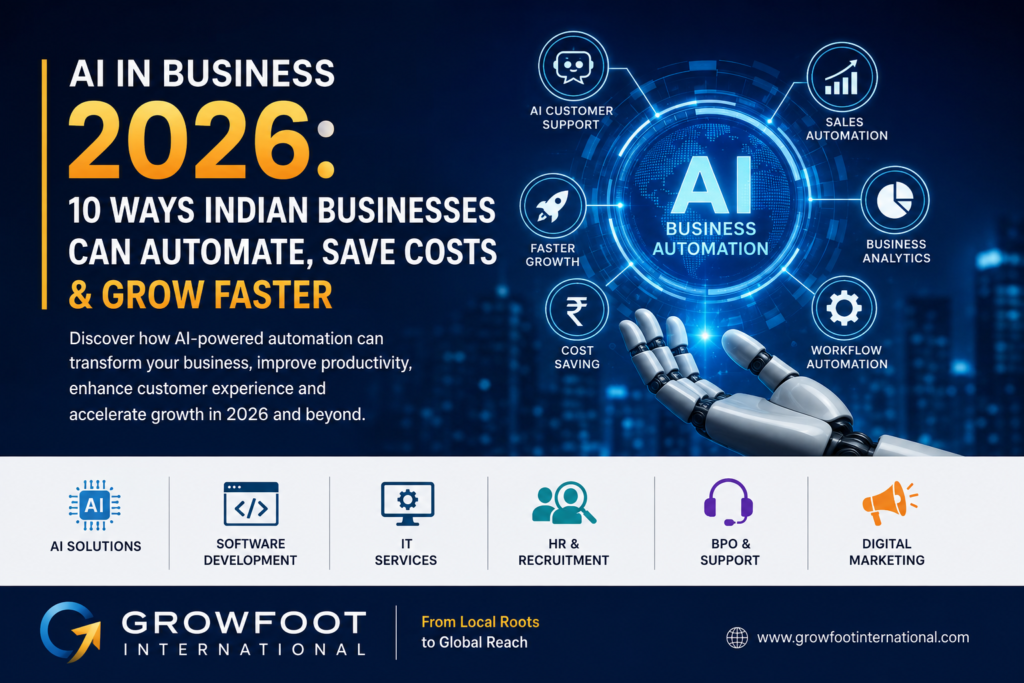
AI in Business 2026: 10 Ways Indian Businesses Can Automate, Save Costs & Grow Faster
Published by Growfoot International | AI • IT • Software Development • Business Automation
Artificial Intelligence is no longer just a technology trend reserved for large corporations.
In 2026, AI is becoming a practical business tool for startups, MSMEs, retailers, service companies, manufacturers, BPOs, professional firms and growing enterprises across India.
From answering customer enquiries and generating leads to automating HR processes, analysing business data and improving cybersecurity, AI can help businesses work faster, reduce repetitive tasks and make better decisions.
But there is an important shift happening.
Businesses are moving beyond simply asking “How can we use AI?”
The more important question is:
“Which parts of our business should we automate with AI, and how can we do it securely and profitably?”
Recent technology outlooks highlight AI-native development, multi-agent systems, domain-specific AI, AI security and proactive cybersecurity among important technology directions for 2026.
For Indian businesses, this creates a major opportunity.
What Is AI Business Automation?
AI business automation means using artificial intelligence, software, data and automated workflows to perform repetitive or decision-support tasks with less manual intervention.
Traditional automation generally follows predefined rules.
For example:
If a customer submits a form → send an email.
AI-powered automation can go further.
For example:
Customer submits an enquiry → AI understands the requirement → identifies the appropriate service → qualifies the lead → creates a CRM record → sends a personalised response → alerts the sales team.
This combination of AI and automation can transform how businesses operate.
10 Ways AI Can Transform Indian Businesses in 2026
1. AI-Powered Customer Support
Customer support is one of the easiest areas for businesses to begin their AI journey.
An AI chatbot or virtual assistant can help customers with:
- Product information
- Service enquiries
- Frequently asked questions
- Order status
- Appointment requests
- Technical support
- Complaint registration
- Lead qualification
- Basic troubleshooting
Instead of forcing customers to wait for a human representative, AI can provide immediate first-level assistance.
Human employees can then focus on complex issues that require judgement or personal interaction.
Example
A software company receives hundreds of WhatsApp enquiries every day.
Instead of manually answering every basic question, an AI assistant can handle initial conversations and transfer qualified prospects to the sales team.
Result:
Faster response + fewer repetitive tasks + better lead management.
2. AI Lead Generation and Sales Automation
Sales teams spend significant time searching for prospects, following up with leads and updating CRM records.
AI can automate many of these activities.
A business can build an AI-powered sales workflow that:
- Captures leads from the website
- Reads the customer’s enquiry
- Identifies customer requirements
- Scores the lead
- Assigns the lead to the right salesperson
- Sends a personalised response
- Creates follow-up reminders
- Updates the CRM
- Analyses conversion performance
This can help sales teams spend more time selling and less time performing administrative work.
3. AI-Powered Marketing
Marketing is another area where AI can dramatically increase productivity.
AI can assist with:
- Blog writing
- Social media content
- Advertisement ideas
- SEO research
- Keyword analysis
- Email campaigns
- Customer segmentation
- Content personalisation
- Campaign analysis
- Lead nurturing
However, businesses should not treat AI as a replacement for marketing strategy.
The best approach is:
Human strategy + AI productivity + data-driven decisions.
AI can produce content quickly, but businesses still need human oversight to maintain brand identity, accuracy and trust.
4. AI for HR and Recruitment
Recruitment can involve hundreds of repetitive activities.
AI can help HR teams with:
- Resume screening
- Candidate matching
- Interview scheduling
- Candidate communication
- Job-description creation
- Employee onboarding
- HR FAQs
- Training recommendations
- Employee feedback analysis
For example, a recruitment company receiving 1,000 resumes for a position could use AI to identify candidates based on predefined job-related criteria before the HR team performs the final review.
This can significantly reduce administrative workload.
Important
AI should support HR decisions rather than blindly make high-impact employment decisions.
Human review, transparency and appropriate governance remain important.
5. AI-Powered Business Analytics
Many businesses already have valuable data.
The problem is that they don’t always use it effectively.
Businesses may have data from:
- Sales
- Customers
- Inventory
- Accounting
- Marketing
- Employees
- Website traffic
- Customer support
- CRM systems
AI can help convert this information into useful insights.
For example:
Which products are selling fastest?
Which customers are most valuable?
Which marketing campaign produces the best leads?
Which salespeople are converting the most enquiries?
Where are we losing customers?
Instead of looking through multiple spreadsheets, management can use dashboards and AI-assisted analytics to identify important trends faster.
6. AI for Business Process Automation
Every business has repetitive processes.
Examples include:
- Invoice processing
- Data entry
- Document processing
- Email classification
- Report generation
- Customer onboarding
- Ticket assignment
- Appointment scheduling
- Internal approvals
- Notifications
AI can be integrated into these workflows to reduce manual intervention.
For example:
Invoice received → AI reads invoice → extracts information → validates data → sends it for approval → updates accounting software.
This is where AI becomes more than a chatbot.
It becomes part of the company’s operating system.
7. AI-Powered IT Support
Businesses increasingly depend on technology.
When systems fail, productivity can fall quickly.
AI-powered IT support can help companies with:
- First-level troubleshooting
- Ticket classification
- Incident prioritisation
- Knowledge-base search
- Automated responses
- Device monitoring
- System alerts
- Employee IT assistance
- Common software problems
An AI support assistant can potentially identify simple problems before they become major support incidents.
For larger organisations, AI agents can also assist IT teams with monitoring and workflow execution, provided appropriate permissions, controls and human oversight are implemented.
8. AI and Cybersecurity
As businesses adopt AI, cybersecurity becomes even more important.
AI introduces new risks including:
- Data leakage
- Unauthorised AI tools
- Prompt injection
- Credential exposure
- AI application vulnerabilities
- Deepfake-based impersonation
- Uncontrolled AI agents
Gartner’s 2026 cybersecurity guidance specifically highlights AI application compromise as an emerging critical threat and recommends expanding security controls to cover AI applications and agentic tools.
Businesses should therefore think about AI security before deploying AI at scale.
A good AI security strategy can include:
- Access control
- Data protection
- User permissions
- Secure API integration
- Monitoring
- Logging
- Human approval for sensitive actions
- Regular security assessments
- Employee AI-use policies
AI should make your business more productive — not create a new security weakness.
9. AI Agents and Agentic AI
One of the most important developments in 2026 is the evolution from AI assistants toward AI agents.
A traditional chatbot generally responds to a user.
An AI agent can potentially:
Understand → Plan → Use tools → Execute tasks → Check results → Take the next action.
For example, imagine an AI sales agent receiving a new enquiry.
It could:
- Understand the enquiry
- Identify the customer’s requirement
- Search the company’s product/service database
- Prepare a response
- Create a CRM record
- Schedule a follow-up
- Notify the sales team
This is significantly more powerful than simply generating text.
Multi-agent systems are also emerging, where multiple specialised AI agents work together on different parts of a workflow. Gartner lists multi-agent systems among its strategic technology trends for 2026.
However, autonomous systems require strong controls.
AI agents should have carefully defined permissions, monitoring, audit trails and human escalation procedures.
10. AI-Powered Software Development
AI is also changing how software is designed and developed.
Modern development teams can use AI to assist with:
- Coding
- Debugging
- Testing
- Documentation
- Code reviews
- Database development
- API integration
- UI development
- Software maintenance
AI-native development platforms are among the technology trends identified for 2026.
But faster development does not automatically mean better software.
Security, architecture, testing, scalability and human review remain essential.
The goal should be:
Build faster without compromising quality or security.
Why Indian MSMEs Should Start Using AI
India’s MSME ecosystem represents a huge opportunity for practical AI adoption.
Many smaller businesses face similar challenges:
- Limited manpower
- Increasing operating costs
- Difficulty hiring skilled employees
- Large amounts of repetitive work
- Slow customer response
- Manual reporting
- Fragmented software systems
- Cybersecurity concerns
AI can help address many of these problems.
The key is not to implement AI everywhere.
Instead, identify the business processes where automation can produce measurable value.
Recent work around AI solutions for India’s MSME ecosystem also demonstrates increasing emphasis on practical, deployable AI systems that integrate with existing digital infrastructure.
How Much Can AI Save a Business?
There is no universal percentage that applies to every company.
The potential benefit depends on:
- Number of employees
- Business processes
- Transaction volume
- Existing software
- Data quality
- Customer volume
- Automation complexity
- Implementation quality
For example, a company spending hundreds of employee-hours every month on repetitive data processing may have a strong automation opportunity.
The correct way to evaluate AI is therefore not:
“How much does AI cost?”
Instead ask:
“How much time, money and revenue can this process generate or save after automation?”
The Right AI Strategy for Your Business
Businesses should avoid adopting AI simply because it is trending.
A better approach is a structured five-step process.
Step 1: Identify Repetitive Work
List tasks that employees perform repeatedly.
Step 2: Measure the Current Cost
Calculate:
- Employee hours
- Processing time
- Error rates
- Customer waiting time
- Lost opportunities
Step 3: Identify AI Opportunities
Determine which processes can be improved through:
- AI
- Automation
- Software integration
- Chatbots
- AI agents
- Data analytics
Step 4: Start Small
Choose one high-value, low-risk process.
For example:
Customer enquiry automation
instead of trying to automate the entire company on day one.
Step 5: Measure ROI
Track:
- Time saved
- Cost reduction
- Revenue generated
- Response time
- Conversion rate
- Customer satisfaction
Then scale the successful solution.
AI Implementation Roadmap for Businesses
Phase 1 — AI Audit
Understand your current business processes, software and data.
Phase 2 — Opportunity Identification
Identify processes where AI can produce measurable benefits.
Phase 3 — Pilot Project
Implement one practical AI automation.
Phase 4 — Integration
Connect AI with CRM, website, ERP, WhatsApp, email, databases or other business systems.
Phase 5 — Security & Governance
Define permissions, monitoring, data protection and human oversight.
Phase 6 — Scale
Expand successful automation to additional departments.
Why Businesses Need an AI Technology Partner
Buying an AI tool is easy.
Building AI into a business is much harder.
Businesses need to consider:
Business strategy
Software development
Data
Automation
Cybersecurity
Integrations
User experience
Scalability
Ongoing support
This is why companies should look for a technology partner capable of understanding both business requirements and technology implementation.
How Growfoot International Can Help
At Growfoot International, we help businesses use technology to improve operations, productivity and growth.
Our technology and business solutions can include:
AI Solutions
AI-powered applications, assistants, automation and business workflows.
Software Development
Custom software designed around your business processes.
Web Development
Business websites, portals, web applications and digital platforms.
Business Automation
Automation of repetitive workflows to reduce manual work and improve productivity.
IT Services
Technology support and solutions designed around business requirements.
HR & Recruitment Services
Technology-enabled recruitment and HR support for growing organisations.
BPO & Support Services
Customer support, technical support and business process outsourcing solutions.
Digital Marketing
SEO, social media, online advertising and digital growth strategies.
The objective is simple:
Use technology to solve real business problems.
AI Is Not About Replacing People
One of the biggest misconceptions about AI is that businesses must choose between employees and automation.
The better approach is:
AI handles repetitive work.
Employees handle judgement, relationships, creativity and strategy.
A well-designed AI system should help employees become more productive rather than simply removing human involvement.
For sensitive areas such as finance, compliance, HR decisions and customer-critical operations, businesses should maintain appropriate human oversight.
What Will Business Technology Look Like in 2026 and Beyond?
The next phase of digital transformation will not be about using one AI chatbot.
It will be about connecting AI to the entire business.
Imagine a company where:
AI generates leads → AI qualifies leads → CRM updates automatically → sales team receives priority leads → proposals are generated → customer support is automated → invoices are processed → management receives real-time analytics.
This is the direction in which business automation is moving.
AI becomes embedded into workflows rather than existing as a separate application.
Final Thoughts
2026 is an important year for businesses considering AI.
The competitive advantage will not necessarily go to companies that use the most AI.
It will go to companies that use the right AI, in the right processes, with the right controls.
For Indian businesses, particularly MSMEs and growing companies, this creates an opportunity to improve productivity without requiring massive technology investments.
Start with one process.
Measure the results.
Improve it.
Then scale.
The future of business is not simply digital. It is intelligent, automated and connected.
Ready to Make Your Business AI-Powered?
At Growfoot International, we help businesses identify practical opportunities for AI, software development, IT solutions, automation, digital transformation and business process improvement.
Whether you want to automate customer support, develop custom software, build an AI-powered business application, improve your website, automate internal processes or strengthen your digital infrastructure, the first step is understanding your business requirements.
Talk to Growfoot International and discover where AI can create measurable value for your business.
Growfoot International
From Local Roots to Global Reach
AI Solutions | Software Development | IT Services | HR Services | BPO | Digital Marketing
Frequently Asked Questions
What is AI business automation?
AI business automation combines artificial intelligence with software workflows to automate repetitive tasks, analyse information, assist employees and improve business processes.
Is AI useful for small businesses?
Yes. Small businesses can start with focused applications such as customer support, lead management, marketing, document processing, HR and reporting.
How can AI help Indian MSMEs?
AI can help MSMEs improve productivity, automate repetitive tasks, improve customer response, analyse business data and compete more efficiently.
What is Agentic AI?
Agentic AI refers to AI systems capable of planning and taking actions toward defined goals rather than simply generating responses. More autonomous systems require appropriate permissions, monitoring and governance.
Is AI safe for business?
AI can introduce new security and privacy risks. Businesses should use access controls, data protection, monitoring, secure integrations and human oversight when implementing AI.
Should my business build custom AI software?
Custom AI software can make sense when existing tools do not adequately support your business processes or when integration, data control and custom workflows are important.
How should a business start its AI journey?
Start by identifying repetitive, measurable business processes. Select one high-value and relatively low-risk use case, implement a pilot, measure ROI and then scale.